 Image 1 of 1
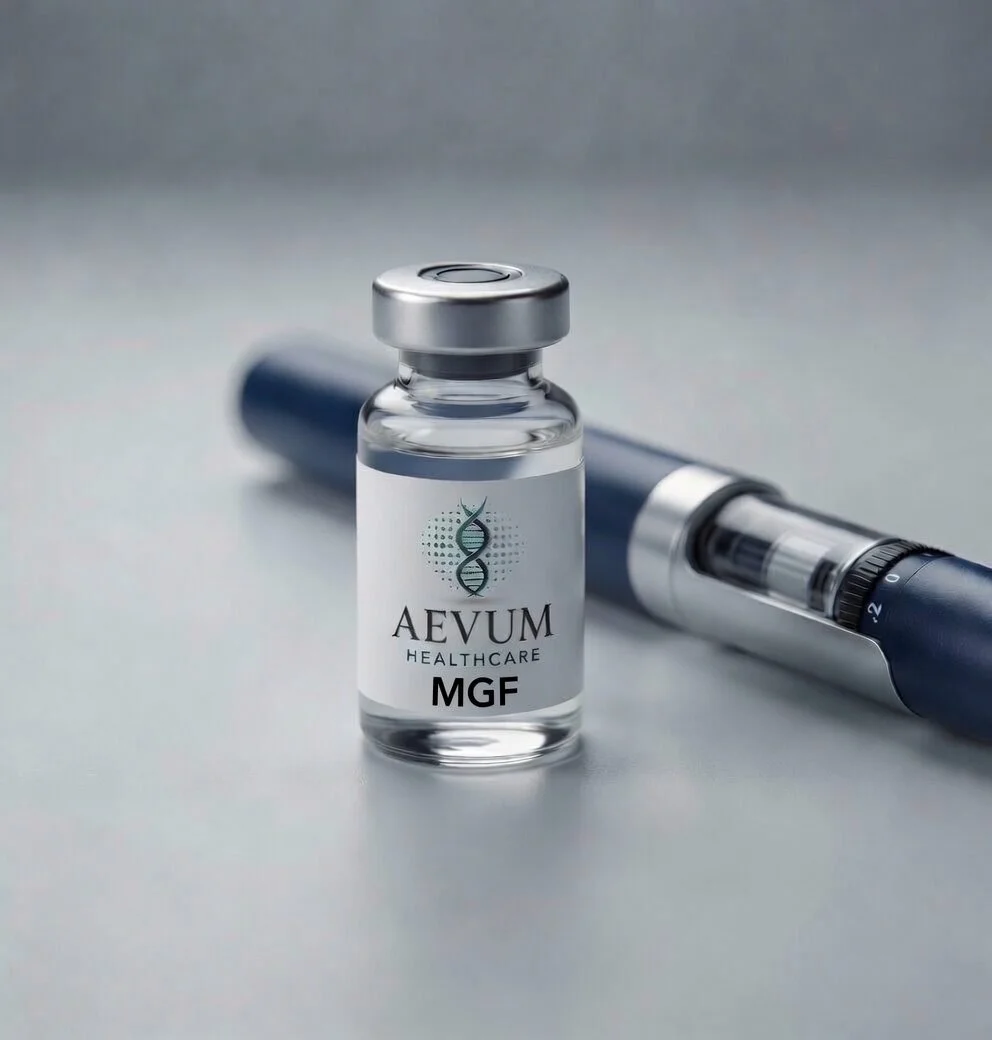
MGF Mechano Growth Factor
MGF (Mechano Growth Factor) is a splice variant of Insulin-like Growth Factor-1 (IGF-1), specifically the IGF-1Eb isoform. It is naturally produced by muscle tissue in response to mechanical overload, damage, or injury.
Key Characteristics:
Structure: Local isoform of IGF-1 with a unique 24-amino acid C-terminal extension (E-peptide)
Mechanism: Activated following muscle stress or micro-tears; promotes satellite cell activation, proliferation, and fusion with existing muscle fibers
Action: Stimulates muscle repair, hypertrophy, and hyperplasia through localized anabolic signaling
Half-life: Very short (only a few minutes) in its native form, which is why pegylated versions (PEG-MGF) are often used in research
Research Applications:
Muscle damage repair and regeneration studies
Satellite cell activation and myogenesis research
Muscle hypertrophy and hyperplasia models
Recovery from intense exercise or injury
Age-related muscle loss (sarcopenia) investigations
Tissue engineering and localized growth factor signaling
MGF is highly valued in laboratory research for its role as a “damage sensor” that triggers rapid muscle repair and growth. It is considered one of the key local mediators of exercise-induced muscle adaptation.
For laboratory research use only. Not intended for human or veterinary use.
MGF Mechano Growth Factor
MGF (Mechano Growth Factor) is a splice variant of Insulin-like Growth Factor-1 (IGF-1), specifically the IGF-1Eb isoform. It is naturally produced by muscle tissue in response to mechanical overload, damage, or injury.
Key Characteristics:
Structure: Local isoform of IGF-1 with a unique 24-amino acid C-terminal extension (E-peptide)
Mechanism: Activated following muscle stress or micro-tears; promotes satellite cell activation, proliferation, and fusion with existing muscle fibers
Action: Stimulates muscle repair, hypertrophy, and hyperplasia through localized anabolic signaling
Half-life: Very short (only a few minutes) in its native form, which is why pegylated versions (PEG-MGF) are often used in research
Research Applications:
Muscle damage repair and regeneration studies
Satellite cell activation and myogenesis research
Muscle hypertrophy and hyperplasia models
Recovery from intense exercise or injury
Age-related muscle loss (sarcopenia) investigations
Tissue engineering and localized growth factor signaling
MGF is highly valued in laboratory research for its role as a “damage sensor” that triggers rapid muscle repair and growth. It is considered one of the key local mediators of exercise-induced muscle adaptation.
For laboratory research use only. Not intended for human or veterinary use.